Fintechzoom Ford Stock: Analyzing the Shift to EV
Note: FintechZoom Pro is independent and not affiliated with, endorsed by or associated with FintechZoom.com or FintechZoom.io. "FintechZoom" in this title is the search term readers use, not a reference to that company. This guide is for information only, not financial advice.
FintechZoom Ford stock refers to shares of Ford Motor Company (NYSE: F), a car maker founded in 1903 whose share price depends on its earnings, its costly shift to electric vehicles (EVs), the economy and competition from rivals such as GM, Toyota and Tesla. This guide explains Ford's recent performance, the factors that move the stock, how it compares with competitors and the main points behind its dividend and EV strategy. It is general information, not investment advice.
November 2026 update. Ford Motor Company closed at $12.44 on November 6, 2026.
Source: Yahoo Finance historical prices.
Ford at a glance:
- Business: cars, trucks and SUVs, including classic models such as the Mustang and F-Series trucks.
- EV models: Mustang Mach-E and F-150 Lightning.
- Ticker: F on the New York Stock Exchange.
- Known for: a long manufacturing history, a loyal customer base and a high dividend yield.
- Biggest issues: EV segment losses, production costs and intense competition.

What is meant by FintechZoom Ford stock?
"FintechZoom Ford stock" is a search term people use when looking for news, analysis and forecasts about Ford Motor Company shares. FintechZoom Pro is an independent publication that explains the numbers and events behind Ford's share price; it is not a trading platform.
Ford is known for its long history of car innovation and manufacturing and has been a major player in the worldwide car market for over a century. Models such as the Mustang and F-Series trucks have earned it a loyal customer base and a prominent place on the stock market. In recent years Ford has responded to market changes with investments in electric vehicles and efforts at global growth.
How has Ford stock performed recently?
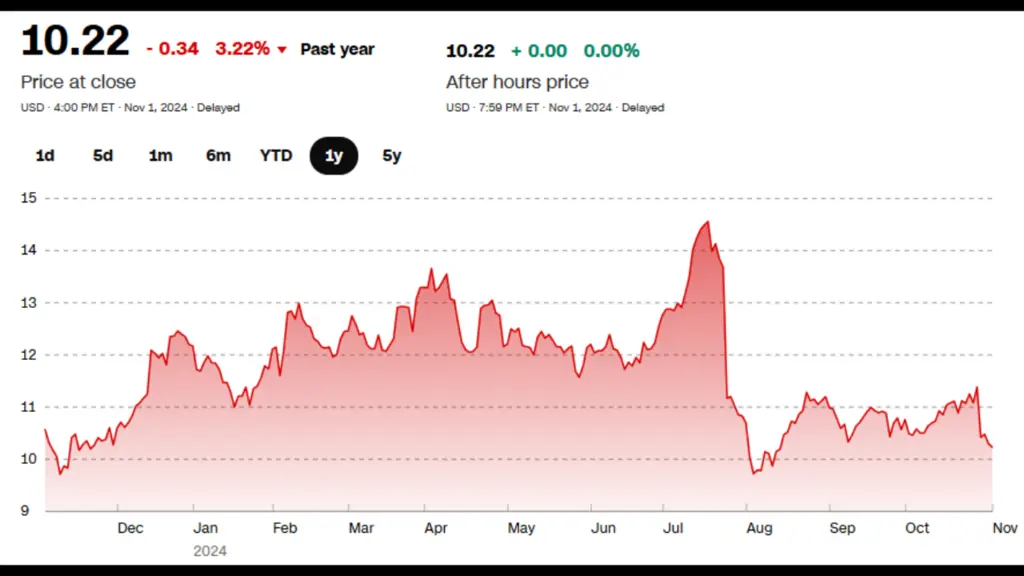
Ford's stock has fluctuated widely; on November 3, 2024 it was trading at $10.22. You can follow the live price in the chart below.
That price reflected both risks and opportunities. In the months before, higher production costs and inflation weighed on Ford's share price and on the whole car market. Despite these obstacles, Ford's investment in EVs has reshaped the brand.
The aim is to win a share of the growing electric vehicle market, where competitors such as Tesla and Rivian stock maker Rivian are already established. Investors also react to Ford's quarterly profit and revenue releases. Ford has faced operational difficulties, but demand for EVs and progress in battery technology have helped support its position.
What should investors track when following Ford stock?
Investors following Ford usually track live price and volume, technical indicators and news sentiment. These are available from mainstream market data services and charting tools such as the widget above.
- Real-time price data: live price and trading volume let active investors see moves as they happen.
- Technical indicators: moving averages and volume charts show how Ford's price has behaved against its own history.
- News and sentiment: industry news, earnings coverage and social sentiment explain what is driving the automotive sector, both short term and long term.
What factors change Ford's stock value?
Ford's share price is driven mainly by its financial results, its EV transition, the economy, customer demand and competition.
| Factor | What to watch | Typical effect |
|---|---|---|
| Financial performance | Quarterly earnings, revenue, profit margins | Strong results lift confidence; falling earnings weigh on the price |
| EV transition | Mustang Mach-E and F-150 Lightning sales, EV segment losses | Success supports long-term value; production problems hurt |
| Macroeconomy | Interest rates, inflation, raw material costs | Higher costs and loan rates squeeze margins and car demand |
| Customer demand | Sales of classic models and EVs, brand sentiment | Loyalty supports the stock; falling demand hurts |
| Competition | GM, Toyota, Tesla, Hyundai | Rival success pressures market share |
How do financial results affect Ford stock?
Quarterly earnings and profit margins are key indicators for Ford's share price. Experienced investors use them to judge financial stability and profitability. Positive results support confidence, while falling earnings or revenue can push the price lower.
Why does the EV transition matter for Ford?
Ford's EVs, such as the Mustang Mach-E and F-150 Lightning, are central to the stock's long-term potential. Success could benefit the stock as interest in sustainable transport grows. Problems in EV production, or competition from companies such as Tesla stock maker Tesla, could limit Ford's ability to profit from the shift.
How do macroeconomic factors affect Ford?
Interest rates and raw material costs directly affect Ford's production costs and profit margins. High inflation raises manufacturing costs, and higher loan rates reduce consumer demand for new cars, since many buyers finance their purchase.
How do customer demand and sentiment affect Ford?
Demand for Ford's classic vehicles and its newer EVs shapes its market position and share price. Customer preferences shift over time, and growing interest in environmentally friendly vehicles can change Ford's sales mix and revenue. Positive sentiment and brand loyalty help support the stock, while weaker demand or negative public opinion has the opposite effect.
Who are Ford's main competitors?
Ford competes with traditional giants such as General Motors and Toyota, as well as EV makers such as Tesla. Rivals' performance affects Ford's market share and pushes it to innovate. Its ability to stand out with distinctive models and technology matters for attracting investors and keeping an edge.

How does Ford compare with its competitors?
Ford competes with some of the biggest names in the car industry; the table below compares how it stood against them at the time of writing.
| Factor | Ford | Tesla | Hyundai | Rivian |
| EV Market | Aims to merge its history with current technology but supply chain issues have put strains on its EV production. | Leading EV manufacturer with popular models such as the Model 3 and benefits from strong brand loyalty. It has a competitive advantage in production efficiency and battery technology. | Quickly gained ground in the EV market with models such as the Kona Electric. Known for its affordability and consistent production capabilities. | Newer EV manufacturer but despite its small production scale compared to Ford, Rivian's unique positioning and innovation-focused strategy have gained attention. |
| Innovation and Technology | Focused on EV motors, hybrids, and its BlueCruise autonomous driving technology. However, in terms of software and battery technology, it is still catching up to more EV-focused competitors. | Sets the standard for electric vehicle technology with its complicated self-driving capabilities and integrated Supercharger network. | Investment in the E-GMP platform enables faster charging and better range. | Stands out for its adventure-focused technologies, such as off-road capability and adjustable driving modes. |
| Market Reach | Global footprint and established production network allow it to develop new models faster than upstart competitors such as Rivian. | Substantial production capacity at plants in the US, China, and Germany, which allows it to effectively satisfy worldwide demand. | Proven production capabilities in SK and global market reach make it a powerful rival. Its ability to manufacture EVs at reduced costs while retaining quality has helped it extend its EV footprint. | Limited production capacity presents issues in rising to meet demand. However, its focus on a specialized industry allows it to remain competitive in the United States. |
| Financial Performance | Stock performance shows a cautious investor attitude as it moves to electric vehicles. Investors view Ford's EV journey as a work in progress with a focus on profitability despite the substantial expenses. | Highly valued stock due to consistent EV innovation and high gross margins. Tesla showed profitability and market domination in the electric vehicle sector. | Investors like Hyundai's consistent growth, especially in the EV industry. | High-profile supporters and strategic focus on adventure-oriented EVs have sparked investor attention. However, Rivian's small manufacturing and income make it a more speculative investment. |
What is the latest news and outlook for Ford stock?
Ford's outlook depends heavily on its EV strategy, which has been losing money. In late 2024 Ford reported a projected loss of $1 billion from its EV segment, and the stock fell about 4% on the news.
As new vehicles launch, Ford's ability to scale manufacturing and meet demand will be important. At the time, analysts said that efficient management of the supply chain and production costs could improve investor confidence and stock performance. Rivals such as Tesla and Hyundai remain tough competition for market share.

Is Ford stock worth considering?
Whether Ford fits a portfolio depends on your own goals and risk tolerance; it combines a high dividend with the risks of an expensive EV transition. In late 2024, Ford's dividend yield was about 5.6%, which attracted income-focused investors. Dividends are not guaranteed and can be cut.
| Points in favour | Points of concern |
|---|---|
| Strong legacy brand and loyal customers | Large losses in the EV segment |
| Significant revenue from traditional vehicles | Sensitivity to interest rates and inflation |
| High dividend yield (about 5.6% in late 2024) | Intense competition from GM, Toyota, Tesla and Hyundai |
Key takeaways
- Ford traded at $10.22 on November 3, 2024; see the update box above for a newer price.
- Earnings, the EV transition, the economy, demand and competition drive the share price.
- Ford projected a loss of about $1 billion in its EV segment in late 2024, and the stock fell about 4%.
- The dividend yield was about 5.6% in late 2024, but the EV strategy carries financial risk.
Ford stock FAQs
Why is Ford's stock price so low?
Ford's stock is heavily affected by macroeconomic factors, even when the company performs well. Growing an auto business requires very large spending, which limits how much profit margins can expand, and investors price that in.
Could Ford stock hit $100?
Ford traded around $10 to $12 in 2024 to 2026, so a move to $100 would require roughly an eightfold or larger rise. That is not a realistic near-term expectation, and no one can predict long-term prices.
Is Ford a good share?
Supporters point to Ford's strong cash position, low share price and high dividend, while critics highlight its EV losses and competition. Whether it suits you depends on your goals; consider speaking to a licensed adviser.