Fintechzoom GE Stock - Key Insights and Latest Stats in 2026
Note: FintechZoom Pro is independent and not affiliated with, endorsed by or associated with FintechZoom.com or FintechZoom.io. "FintechZoom" in this title is the search term readers use, not a reference to that company. This guide is for information only, not financial advice.
FintechZoom GE stock refers to General Electric's shares (NYSE: GE), which since the 2023 GE HealthCare and 2024 GE Vernova spin-offs represent GE Aerospace, the jet engine and aviation services business. This guide explains what GE stock is today, its key figures such as market capitalization, P/E ratio and dividend yield, how to analyse the stock and the main points to weigh before investing. FintechZoom Pro is an independent publication; "FintechZoom GE stock" is simply the search term. It is general information, not investment advice.
Key points:
- General Electric is one of the best-known US industrial companies and has split into three separately listed businesses.
- The GE ticker now belongs to GE Aerospace; GE HealthCare (GEHC) and GE Vernova (GEV) trade separately.
- Figures such as market cap, P/E ratio and dividend yield help you judge the stock, but they change constantly.
- Stock prices can fall as well as rise, so research GE's financials and your own risk tolerance before deciding.
November 2026 update. GE Aerospace closed at $323.24 on November 6, 2026.
Source: Yahoo Finance historical prices.
What is GE stock?
GE stock is the publicly traded share of General Electric, now operating as GE Aerospace, listed on the New York Stock Exchange under the ticker GE. For decades, General Electric was a multinational conglomerate that gave investors exposure to many industries, including aviation, healthcare and energy.

That changed when GE split into three companies. Understanding GE stock today means knowing which business the ticker now represents and which factors drive its results.
| Company | Ticker | Business | Separation |
|---|---|---|---|
| GE Aerospace | GE | Jet engines and aviation services | The remaining company after both spin-offs |
| GE HealthCare | GEHC | Medical technology | Spun off in early 2023 |
| GE Vernova | GEV | Power and renewable energy | Spun off in April 2024 |
What is the GE stock price today?
The live chart below shows the latest GE share price; the November 2026 update above gives a dated closing price.
What are the key facts about GE stock?
The main figures to watch are market capitalization, the price-to-earnings ratio, dividend yield, business segments and strategic moves. The numbers below were reported around the time this article was first written in 2024 and have changed since.
| Metric | Figure at the time (2024) | What it tells you |
|---|---|---|
| Market capitalization | $178.95 billion | Total value of outstanding shares |
| P/E ratio | 53 | How much investors pay per dollar of earnings |
| Dividend yield | 0.67% | Annual dividends as a share of the stock price |
1) What does GE's market capitalization show?
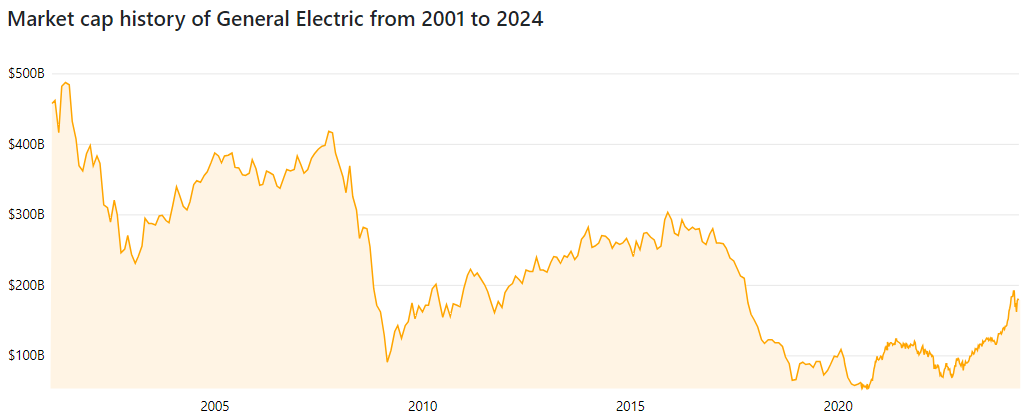
At the time of writing, GE's market capitalization was $178.95 billion, the total value of all its outstanding shares. A market value of that size reflects the company's scale and resources, though large companies can still see their share prices fall in downturns.
2) What does GE's P/E ratio mean?
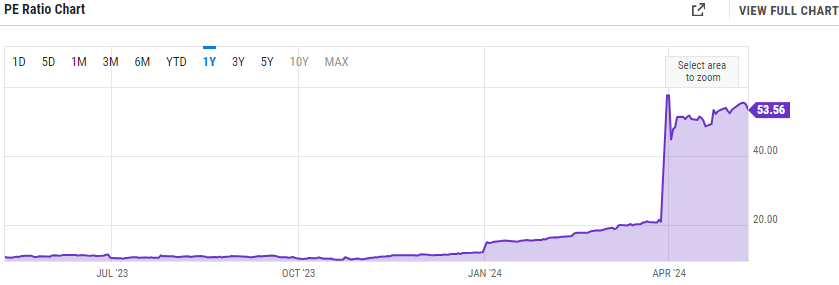
GE's P/E ratio was 53 at the time, meaning investors paid about $53 for every dollar of annual earnings. The P/E ratio helps judge whether a stock looks expensive or cheap relative to its earnings potential. A high P/E usually means investors expect strong future growth, which also raises the risk if that growth disappoints.
3) What dividend does GE pay?
GE pays a modest dividend. With a dividend yield of 0.67% up to 2025, dividends gave a small return on top of any share price change. The yield is not high, but it offers some income to investors who are also looking for long-term growth. Dividends are not guaranteed and can change.
4) Which business segments drive GE?
Before the split, GE's portfolio covered aviation, healthcare and renewable energy; today the GE ticker is focused on aviation. GE Aerospace benefits from demand for air travel, engines and servicing. GE HealthCare, which benefits from advances in medical technology, and GE Vernova, the energy business, are now separate companies.
5) What strategic moves have shaped GE?
Restructuring and the separation into three public companies, focused on aviation, healthcare and energy, have been the defining moves. The split was intended to improve operational focus, efficiency and innovation in each business, and it has been a major factor in the stock's performance in recent years.
How do you analyse GE stock?
Review the price history, key ratios, company filings and recent news, and compare them over time and against peers. Financial news sites, including FintechZoom Pro, gather data and articles from various sources, but always check figures against primary sources such as GE's own reports.
- Check price performance: use charts to see how the share price has moved over different periods.
- Review key figures: look at the P/E ratio, dividend yield, earnings and cash flow.
- Read company reports: quarterly earnings and annual reports show how each business is performing.
- Follow the news: industry trends, such as air travel demand, and company events affect the price.
- Stay informed: review your research regularly and adjust your plan if facts change.
What should you consider before investing in GE stock?
Consider valuation, your time horizon and how you will manage risk, rather than trying to time the market perfectly. Some investors look for price drops during broad market downturns that do not reflect a change in the company's health, or watch for growth in key industries. Others take partial profits after large gains or use stop-loss orders, which automatically sell if the price falls to a set level. Each approach has trade-offs, and none guarantees a profit.
| Consideration | Why it matters |
|---|---|
| Valuation | A high P/E leaves less room for disappointment |
| Industry exposure | GE now depends heavily on aviation demand |
| Market timing | Downturns can create lower prices but are hard to predict |
| Risk management | Taking partial profits or stop-loss orders can limit losses but may also cut gains |
| Diversification | Holding a single stock concentrates risk |
Key takeaways
- GE has fluctuated during recessions and downturns but remains one of the best-known names in US industry.
- After spinning off GE HealthCare (2023) and GE Vernova (2024), the GE ticker represents GE Aerospace.
- Market cap, P/E and dividend yield are useful, but check current figures rather than relying on older data.
- Make decisions based on your own goals and risk tolerance, ideally with professional advice.
GE stock FAQs
Who owns GE stock?
Large institutional investors hold much of GE's stock. At the time of writing, BlackRock, Capital Research Global Investors and Vanguard were the three largest shareholders.
Is GE a good investment?
It depends on your goals and risk tolerance. GE Aerospace operates in a high-demand industry, but the stock has traded at a high valuation. Many brokers offer fractional shares, so a high share price alone does not stop new investors from buying.
Is GE still a good stock to buy?
General Electric has transformed in recent years through restructuring and the separation of its businesses. Whether it suits you depends on your strategy and risk tolerance. Review GE's financials, growth prospects and current market conditions before deciding.
What will happen with my GE stock?
Its performance will depend largely on GE Aerospace's results and on wider market conditions. GE has spun off both its healthcare unit (GE HealthCare) and its energy business (GE Vernova), so the remaining company is focused on aviation. Quarterly earnings reports and strategy updates give insight into how the investment may perform.
Will GE shareholders get GE HealthCare (GEHC) stock?
Yes. When GE completed the GE HealthCare spin-off in early 2023, existing GE shareholders received GEHC shares based on their GE holdings. GE shareholders also received GE Vernova shares when that business was spun off in April 2024.
Is it too late to buy GE stock?
That depends on your goals. The stock has risen as GE restructured, so future returns may not match what earlier investors saw, although long-term opportunities may remain in aviation. Assess your risk tolerance and consider consulting a financial adviser.