Fintechzoom NIO Stock - An In-Depth Analysis
Note: FintechZoom Pro is independent and not affiliated with, endorsed by or associated with FintechZoom.com or FintechZoom.io. "FintechZoom" in this title is the search term readers use, not a reference to that company. This guide is for information only, not financial advice.
FintechZoom NIO stock refers to NIO Inc. (NYSE: NIO), a Chinese premium electric vehicle maker whose highly volatile share price is driven by delivery numbers, ongoing losses, fundraising, competition in China's EV market and government policy. This guide covers what moves NIO stock, its recent performance, how it handles downturns, its growth strategies and the main risks and opportunities. FintechZoom Pro is an independent publication; "FintechZoom NIO stock" is the search term. It is general information, not investment advice.
November 2026 update. NIO Inc. closed at $3.39 on November 6, 2026.
Source: Yahoo Finance historical prices.
Key points:
- Company: NIO Inc., founded in 2014 and based in China, focused on premium electric SUVs and sedans.
- Listing: debuted on the New York Stock Exchange in September 2018.
- Known for: battery swapping, Battery as a Service (BaaS) and a strong customer community.
- Expansion: growing beyond China, with a push into European markets.
- Main concerns: volatility, continued net losses, heavy competition and reliance on fundraising.
What is NIO Inc.?
NIO is a Chinese electric vehicle company that aims to redefine car ownership through technology and services such as battery swapping. It has attracted global attention with its approach to automotive technology and its focus on innovative EVs. Its New York Stock Exchange listing in September 2018 gave international investors a way to participate in its growth.

Fintechzoom NIO stock live updates
What are the key drivers behind NIO's market performance?
NIO's stock is driven by the growth of the EV market, its technology, government policy and interest from ESG investors.
| Driver | Why it matters |
|---|---|
| EV market growth | Demand is expected to expand as countries shift to cleaner transport |
| Technological innovation | Battery swapping, driver assistance and AI could support growth |
| Government policy | Subsidies, tax breaks and clean-vehicle rules support EV adoption in China |
| ESG investing | Green technology attracts sustainability-focused investors |
How does the EV market affect NIO?
Owning NIO gives exposure to the EV sector, which is expected to grow as countries move toward sustainable energy. Its focus on high-performance electric SUVs positions it in China and potentially in international markets.
Which technologies is NIO known for?
NIO is an innovator in battery swap technology, autonomous driving and artificial intelligence. Investors in NIO are effectively backing these technologies, which could lift the company's growth over time if they succeed commercially.
How do government policies affect NIO?
NIO benefits from policies that encourage EV adoption, such as subsidies, tax breaks and clean-vehicle regulations. These support its position in the Chinese EV market, though policy can also change.
Why does ESG investing matter for NIO?
NIO fits ESG criteria because of its focus on green technology. This appeals to investors seeking sustainable investments. Many other EV makers use the same positioning to attract eco-conscious buyers and investors.
How has NIO stock performed recently?
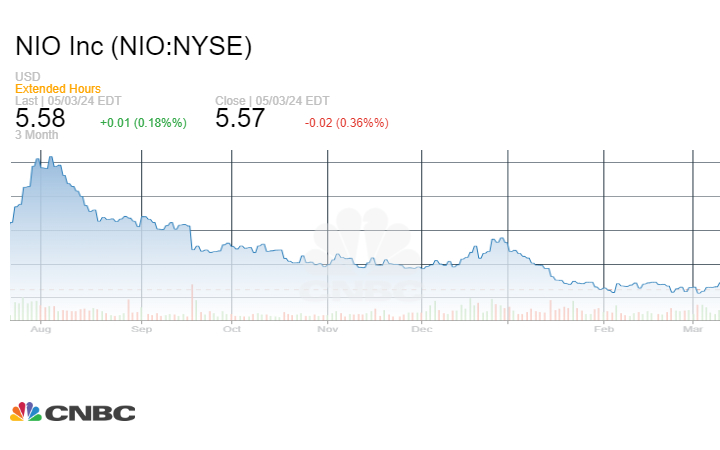
NIO's share price has been very volatile: deliveries have grown, but the stock has fallen sharply at times because of losses and competition. When this section was first written in 2025, deliveries had jumped by 14.3% in March while the share price was down by about 50% for the year. That gap showed that sales growth alone did not remove investor uncertainty.
Why does NIO's stock price fluctuate so much?
The main reasons are a highly competitive, fast-changing EV market and investor reactions to economic conditions and company news.
In 2025, NIO's outlook was mixed. Analysts reacted to slower-than-expected EV sales growth in China and intensifying competition. NIO reported a solid increase in first-quarter deliveries, but there were concerns about whether it could sustain that momentum given limited new model launches and aggressive pricing from rivals such as BYD and XPeng. Some analysts downgraded the stock over weak margins and rising operating challenges, while others stayed cautiously optimistic, pointing to NIO's expanding lineup and the performance of its sub-brands.
What does FintechZoom NIO stock coverage include?
FintechZoom Pro's NIO coverage explains the company's market position, finances, growth plans, risks and the range of analyst opinions. NIO is a prominent player in China's EV industry, so understanding its volatility matters for anyone following the stock. We do not issue our own price targets or recommendations.
NIO stands out for its innovative approach and premium products, and it continues to expand globally. It competes through strategic partnerships and technology, but investor sentiment and market trends can move its shares sharply.
| Topic | What it covers |
|---|---|
| Market analysis | NIO's position in the EV industry, historical performance, market dynamics and investor sentiment |
| Financial health | Revenue growth and profitability challenges, including negative earnings per share (EPS) |
| Future outlook | Market expansion, product diversification, battery swapping and autonomous driving |
| Investment risks | Competition, regulatory change and technological obsolescence |
| Analyst ratings | The mix of positive and cautious analyst views and price targets |
Is NIO financially healthy?
NIO has grown revenue but has not yet achieved profitability, and its earnings per share remain negative. Analysts have expected improvement, but the company still depends on careful cash management and outside funding.
How is NIO dealing with downturns?
NIO responds to downturns with flexible business models, cost cuts, a broader product range, new technology, fundraising and international expansion. Like other companies in the competitive, capital-intensive EV industry, it faces regular market downturns.
- Battery as a Service (BaaS): customers can buy a car without the battery, which lowers the purchase price and adds flexibility for battery upgrades and maintenance.
- Efficiency: optimising manufacturing, supply chain management and operations to cut costs without lowering quality.
- Broader lineup: offering different types of EVs, including SUVs and sedans.
- Technology diversification: investing in autonomous driving and AI to reduce dependence on specific market segments.
- Fundraising: raising capital through public offerings, convertible notes and strategic investments to strengthen cash reserves.
- International expansion: entering markets outside China, such as Europe, and potentially the U.S. in the future.
- Policy support: benefiting from pro-EV policies of the Chinese government.
How does NIO plan to sustain growth?
NIO's growth plans centre on better batteries, driver assistance, production capacity, customer community, fundraising, government support and sustainability.
| Strategy | What NIO is doing |
|---|---|
| Battery technology | Developing higher-density and solid-state battery packs for longer range and faster charging |
| Autonomous driving | Investing in its NIO Pilot advanced driver-assistance system to improve safety and appeal |
| Production capacity | Optimising manufacturing and working with partners such as JAC Motors to add capacity without bearing the full cost of new plants |
| Customer relations | Building a loyal community through NIO Houses, part clubhouse and part showroom |
| Financial strategies | Public offerings and convertible bonds to fund R&D and expansion |
| Government support | Benefiting from China's EV policies and charging network expansion |
| Sustainability | Recycling, lower value-chain emissions and greener vehicles |
Effective cash flow management remains essential for NIO's long-term sustainability, since much of this growth is funded by raising capital.
What are the risks and opportunities of NIO stock?
NIO offers exposure to EV growth and innovative technology, but it carries high volatility, ongoing losses and intense competition. The comparison below summarises both sides.
| Category | Investment Risks | Opportunities |
| Competition | Operates in a crowded market with intense competition from established automotive companies and new entrants. | Entering new international markets could significantly boost sales volume and brand presence. |
| Technology | Rapid advancements in EV technology could make existing models obsolete, requiring continuous innovation. | Investment in battery technology and autonomous driving capabilities could increase NIO's competitive edge and attract tech-savvy consumers. |
| Regulations | Changes in government policies on EVs, such as subsidies and emission standards, could impact sales and profitability. | Growing consumer and regulatory emphasis on sustainability favors EV manufacturers. |
| Supply Chain | Faces supply chain disruptions that affect production capabilities and cost structures. | Diversifying its product line to include more affordable models or different vehicle types could open up new customer segments. |
Key takeaways
- NIO is growing in the EV market through innovation and a wider global presence.
- It adapts to economic swings by focusing on customer experience and technology.
- Environmental alignment and supportive Chinese policies add to its appeal, but losses and competition remain serious risks.
- Check the latest deliveries, quarterly results and cash position before forming a view.
FintechZoom NIO stock FAQs
How did NIO stock perform in March 2025?
NIO's stock declined in late March 2025, closing at $3.67 on March 31, down from $4.37 on March 26. The drop followed the announcement of a $450 million share placement to fund research and development. NIO also reported a fourth-quarter 2024 net loss of $974 million, 32.5% larger than a year earlier, and first-quarter 2025 guidance below analysts' expectations. Vehicle deliveries in March 2025 still rose 26.7% year over year to 15,039 units.
Is it too risky to invest in NIO stock?
NIO carries significant risk because it operates in the volatile EV market, with rapid technological change, intense competition and continued losses. Its innovation and global expansion offer potential growth, so whether it suits you depends on your risk tolerance.
Is NIO profitable?
No. NIO has continued to report net losses, including a $974 million loss in the fourth quarter of 2024. It is trying to improve its finances by diversifying revenue through services such as paid battery swap plans, expanding its battery swap network, cutting costs and using government support.