Fintechzoom AMC Stock | See What Drives Price Changes
Note: FintechZoom Pro is independent and not affiliated with, endorsed by or associated with FintechZoom.com or FintechZoom.io. "FintechZoom" in this title is the search term readers use, not a reference to that company. This guide is for information only, not financial advice.
FintechZoom AMC stock refers to AMC Entertainment Holdings (NYSE: AMC), the world's largest movie theatre chain, whose share price is driven mainly by box office results, its large debt load and swings in retail "meme stock" trading. This guide explains what moves AMC stock, who has shaped its price, the key events such as the 2023 reverse split, and the main risks. It is general information, not investment advice.
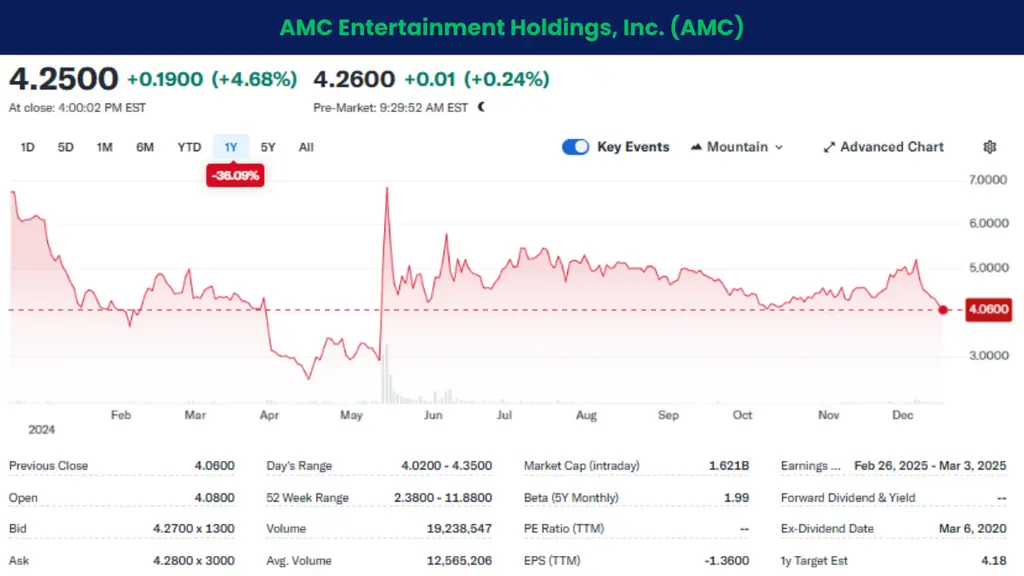
November 2026 update. AMC Entertainment Holdings, Inc. closed at $3.14 on November 6, 2026.
Source: Yahoo Finance historical prices.
AMC at a glance:
- Business: movie theatres in the United States and Europe, earning money from tickets, food and drinks, and advertising.
- Founded: 1920.
- Ticker: AMC on the New York Stock Exchange.
- Known for: the 2021 meme stock rally led by retail investors.
- Biggest issues: high debt, streaming competition and dependence on blockbuster films.
What is AMC Entertainment Holdings?
AMC Entertainment Holdings is the world's largest movie theatre chain, operating cinemas across North America and Europe. It started in 1920 and grew into one of the best-known cinema brands, serving millions of moviegoers each year.
The company was badly hit by two forces: the growth of streaming services and the COVID-19 pandemic, which closed theatres. It survived with heavy borrowing and new share sales, helped by a wave of support from retail investors during the meme stock movement. That history is why AMC is still one of the most debated stocks in the market, with strong views on both sides.
How does FintechZoom cover AMC stock?
FintechZoom Pro explains the news, numbers and events behind AMC's share price so retail investors can understand its moves. Our coverage focuses on:
- Market reactions to AMC's financial updates and box office results.
- Key corporate events such as stock splits and share conversions.
- The drivers and risks that matter for anyone following AMC's price or an AMC stock prediction.
What happened in the AMC stock split?
On August 24, 2023, AMC completed a 1-for-10 reverse stock split, combining every ten shares into one. The aim was to lift the per-share price and make the stock more appealing to institutional investors.
At the same time, AMC converted its AMC Preferred equity units (APEs) into common shares. This removed the APE units and simplified the company's share structure into a single class of ordinary shares.
| Event | Date | What it meant |
|---|---|---|
| Meme stock rally | 2021 | Retail buying and a short squeeze sent the price sharply higher |
| APE conversion | August 2023 | Preferred equity units turned into common shares |
| 1-for-10 reverse split | August 24, 2023 | Ten old shares became one new share |
What are the 5 key factors that move AMC's stock price?
AMC's stock price is driven by box office performance, theatre attendance, its debt and finances, the wider economy and competition from streaming.
| Factor | Why it matters | Effect on the stock |
|---|---|---|
| Box office and movie releases | Ticket and snack sales depend on hit films | Strong release slates support the price |
| Theatre attendance | Visitors drive admissions and concessions | Recovering attendance helps; weak attendance hurts |
| Financial health and debt | Large pandemic-era borrowing must be repaid or refinanced | Debt worries weigh on the stock |
| Economy and markets | Recession and inflation cut leisure spending; rates raise borrowing costs | Weak economy usually hurts |
| Streaming competition | More people watch new films at home | Long-term pressure on demand |
How does box office performance affect AMC?
AMC's revenue depends directly on the films showing in its theatres. High-grossing blockbusters bring in more customers, which lifts admissions and food sales and tends to support the share price.
How do customer behaviour and attendance affect AMC?
Higher attendance means more ticket and concession sales, while the shift to streaming keeps some viewers at home. Theatres have been recovering from the pandemic, but many people now prefer to watch films at home, which limits that recovery.
Why does AMC's debt matter so much?
AMC took on very large debts to survive the pandemic closures, and investors worry about how it will manage or repay them. Financial health is one of the factors that can strengthen or weaken the share price, because heavy interest costs reduce the cash left for the business.
How do the economy and market conditions affect AMC?
Like all stocks, AMC reacts to the wider economy. A recession or high inflation leads people to spend less on leisure such as movies, which cuts box office revenue. Interest rate changes and overall market sentiment also move the price.
How big a threat is streaming?
Streaming is the biggest long-term threat to AMC's business model. When more people stay home for movie night, demand for traditional cinemas falls, which can limit AMC's revenue growth and, over time, its stock price.
Who are the major players behind AMC's rise?
Retail investors, CEO Adam Aron, hedge funds on the other side of the trade, social media communities and the film studios have all shaped AMC's share price.
| Player | Role |
|---|---|
| Retail investors | Coordinated buying on forums such as Reddit's WallStreetBets drove the 2021 rally |
| CEO Adam Aron | Embraced retail shareholders and communicated directly on social media |
| Hedge funds | Held short positions; covering them added to the short squeeze |
| Social media | Reddit, Twitter (X) and YouTube spread the hype |
| Movie studios | Blockbuster franchises bring audiences back to theatres |
How did retail investors affect AMC stock?
Retail investors made AMC one of the central meme stocks of 2021 by buying together and holding. Many traders organised on online forums such as Reddit's WallStreetBets. Their buying pushed the price up and forced institutional investors who had bet against the stock to buy back shares.
What role did CEO Adam Aron play?
AMC CEO Adam Aron leaned into the meme stock movement and positioned himself as a champion of retail shareholders. He communicated with investors on Twitter and through live streams, and AMC used the period's high share price to raise new capital.
How did hedge funds and institutional investors matter?
Many large hedge funds held short positions in AMC, betting that the price would fall. When retail buying surged, these funds had to cover their positions, creating a short squeeze that pushed the price even higher.
Why were social media platforms so important?
Social media gave retail investors a place to share ideas and encourage each other. Reddit's WallStreetBets became a hub for AMC discussion, while Twitter and YouTube influencers amplified the hype.
How do movie studios and content creators affect AMC?
Big studio releases are the main reason people go to theatres. Successful franchises such as Marvel films or Fast & Furious bring crowds, and AMC benefits directly when major studios schedule strong releases.
What are the risks of investing in AMC stock?
The main risks are AMC's heavy debt, falling theatre attendance, dependence on blockbusters, extreme volatility and competition from streaming services.
- Financial vulnerability: AMC still carries large debts. The meme stock wave brought short-term relief, but long-term financial health depends on AMC's ability to produce steady revenue. If attendance does not return to pre-pandemic levels, repaying debt becomes harder, which would hit the stock.
- Declining theatre crowds: more viewers watch films at home. Even as AMC improves the in-theatre experience, many customers prefer streaming services such as Netflix, which threatens attendance and revenue growth.
- Dependence on blockbusters: a weak box office season or few high-profile releases quickly reduces earnings.
- High volatility and speculation: the price often moves on speculative trading rather than business results, so it may not reflect how the company is actually doing.
- Market competition: AMC faces growing competition from streaming services such as Amazon Prime and Disney, a shift the pandemic accelerated and that pressures its business model.
Should you invest in AMC stock?
AMC suits only investors who can accept large price swings; the company still faces high debt and streaming competition, and its price is often driven by speculation.
- Possible upside: a strong film slate, rising attendance or debt reduction could support the price.
- Main downside: heavy debt, share dilution from new stock sales, and shifting viewing habits.
- Before buying: check AMC's latest quarterly results, debt levels and the current share price, and consider how a big loss would affect your finances.
AMC's future depends on adapting to these problems while keeping box office performance strong. Because the stock is volatile and affected by factors outside AMC's control, caution is essential.
FintechZoom AMC stock FAQs
Who owns the most AMC stock?
Large index fund managers such as Vanguard have been among AMC's biggest institutional shareholders, but a large share of the stock is held by retail investors. Check AMC's latest SEC filings for current ownership.
Is it good to invest in AMC stock?
It depends on your risk tolerance. AMC offers exposure to a cinema recovery, but it carries high debt, dilution risk and extreme volatility, so it is a speculative holding rather than a core investment.
How do regular investors affect AMC stock?
Retail investors have a big impact on AMC's price through coordinated buying and holding, as seen in the 2021 meme stock rally and short squeeze.
Why did AMC do a reverse stock split?
AMC's 1-for-10 reverse split on August 24, 2023 raised the per-share price and was completed alongside the conversion of APE units into common shares, simplifying its share structure.