FintechZoom SQ Stock: Block (NYSE: XYZ) in 2026
Note: FintechZoom Pro is independent and not affiliated with, endorsed by or associated with FintechZoom.com or FintechZoom.io. "FintechZoom" in this title is the search term readers use, not a reference to that company. This guide is for information only, not financial advice.
FintechZoom SQ stock refers to Block, Inc., the company formerly called Square, whose shares traded under the ticker SQ until January 2025 and now trade on the NYSE as XYZ; its price is driven mainly by its Square seller business, the growth of Cash App and its exposure to Bitcoin. What began as a simple card payment tool has grown into a group offering point-of-sale systems, digital wallets, small business loans and cryptocurrency services. This guide explains what Block does, its main products, how the stock has moved, past analyst forecasts and the key risks. It is general information, not investment advice.
November 2026 update. Block, Inc. closed at $85.48 on November 6, 2026. Block has traded as XYZ on the NYSE since January 21, 2025. SQ is its former ticker.
Sources: Yahoo Finance historical prices, Block’s ticker change announcement.
Block at a glance:
- Founded: 2009 by Jack Dorsey and Jim McKelvey, as Square.
- Renamed: Block, Inc. in 2021, reflecting its wider focus including Bitcoin and blockchain.
- Ticker: XYZ on the New York Stock Exchange since January 21, 2025 (formerly SQ).
- Main businesses: Square (seller tools), Cash App (consumer payments) and Bitcoin projects.
- Key risks: regulation, competition, crypto volatility and technology or security failures.
What is Square (Block, Inc.)?
Block, Inc., formerly Square, Inc., is a large financial technology company known for transforming digital payments and helping small businesses accept cards. Jack Dorsey and Jim McKelvey founded Square in 2009 with a simple goal: to make payments easier and more accessible for small businesses. Its card readers gave opportunities to small business owners and entrepreneurs who could not afford traditional payment systems.
The company has since expanded into many areas of digital finance, including peer-to-peer payments, Bitcoin and small business financing. Its digital wallet, Cash App, is one of the most popular peer-to-peer payment apps in the United States, and millions of users rely on it for money transfers, stock investing and Bitcoin investments.
What are Block's 7 main financial products and services?
Block's main products are Square POS, Cash App, Square Capital, Square Invoices, Square Payroll, Square Online and its Bitcoin ventures.

| Product | Who it serves | What it does |
|---|---|---|
| Square Point of Sale (POS) | Small businesses | Accepts cards and digital wallets on phones and tablets, with inventory and sales analytics |
| Cash App | Consumers | Instant peer-to-peer payments, stock and Bitcoin investing, Cash Card and Boost |
| Square Capital | Small businesses | Business loans repaid as a share of daily sales |
| Square Invoices | Invoice-based businesses | Professional invoices, automatic reminders and payment tracking |
| Square Payroll | Small businesses | Pays employees and contractors and files payroll taxes |
| Square Online | Sellers going online | E-commerce sites linked to in-person sales |
| Bitcoin ventures | Consumers and the wider ecosystem | Bitcoin buying and storage, and investment in Bitcoin mining |
What is Square Point of Sale (POS)?
Square POS lets small businesses accept many payment methods, such as credit cards and digital wallets, using phones and tablets. It is simple to use and can replace a traditional cash register. Built-in inventory management and sales analytics give owners useful information about their business.
What is Cash App?
Cash App is a digital wallet for sending and receiving money instantly, which also lets users invest in stocks and Bitcoin. It is an easy entry point for new investors. The Boost program and the Cash Card add savings and more convenient payments.
What is Square Capital?
Square Capital provides small business loans with flexible repayment based on daily sales. Because it uses Square's transaction data, it can make more flexible eligibility decisions, especially for businesses with limited credit history. The loans help fund inventory and operations.
What are Square Invoices and Square Payroll?
Square Invoices creates professional invoices with automatic reminders and payment tracking, while Square Payroll handles employee pay and payroll taxes. Invoices integrate with Square POS, so payments and invoicing stay in one place and businesses can manage overdue payments. Payroll calculates and files payroll taxes automatically to help owners stay compliant, and it connects with Square's time-tracking tool for accurate pay and support for employee benefits.
What is Square Online?
Square Online lets businesses quickly set up e-commerce sites that combine in-person and online sales on one platform. Its link with Square POS helps manage inventory and customer data across both channels, and integrations with social media and delivery services help businesses reach more customers.
What are Block's cryptocurrency and blockchain ventures?
Block supports Bitcoin buying and storage through Cash App and has invested in Bitcoin mining, aiming to widen access to crypto technology. These activities fit the broader blockchain-focused vision behind the company's rebranding as Block, Inc.
What is the live price of Block (formerly SQ) stock?
The chart below shows Block's live share price; the stock now trades under the ticker XYZ.
How has SQ stock performed?
Block's shares rose from $71.90 in October 2024 to about $83.89 on March 14, 2025, and closed at $85.48 on November 6, 2026.
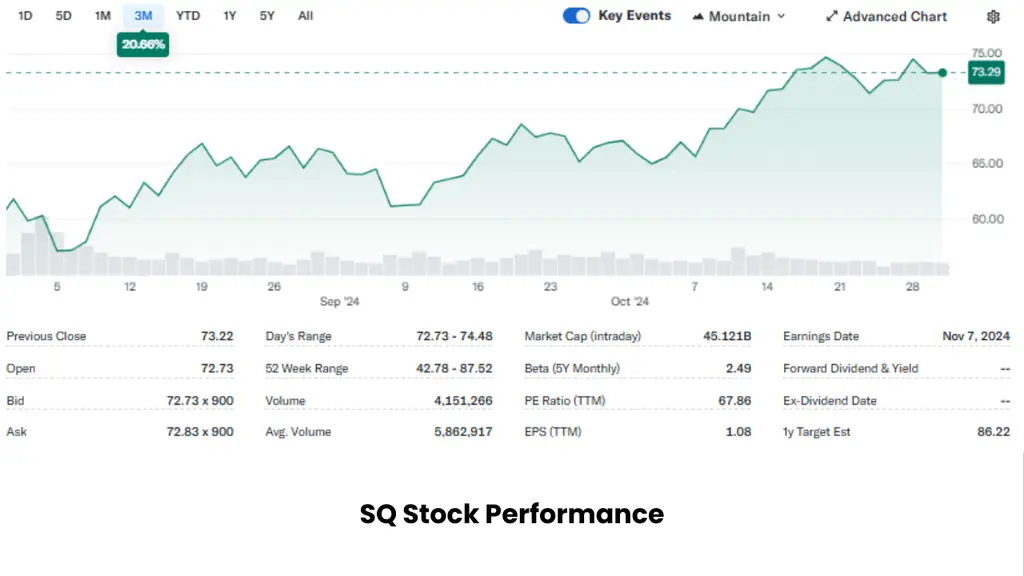
Growth in recent years has been linked to its expanding product lines and its activity in digital banking and cryptocurrency. Cash App has made a notable contribution by increasing user engagement and earnings.
| Date | Share price | Ticker |
|---|---|---|
| October 2024 | $71.90 | SQ |
| March 14, 2025 | About $83.89 | XYZ |
| November 6, 2026 (close) | $85.48 | XYZ |
What did analysts forecast for Block stock?
In early 2025, analysts' average price target was $103.40, within a range of $65.00 to $120.00. At the time, that average implied a potential gain of about 18.20% from then-current levels. One long-term projection published in early 2025 estimated the stock could reach $109.88 by February 2030, a potential 30.98% return over five years. In October 2024, the average analyst target had been $89.13, with a low of $55 and a high of $106. These are historical forecasts, not guarantees, and targets change often.
| Forecast (date) | Average | Low | High |
|---|---|---|---|
| Analyst targets (October 2024) | $89.13 | $55 | $106 |
| Analyst targets (early 2025) | $103.40 | $65.00 | $120.00 |
| Long-term projection for February 2030 (early 2025) | $109.88 | n/a | n/a |
How does blockchain technology affect SQ stock?
Bitcoin support in Cash App has attracted a large user base and added revenue, which ties part of Block's performance to the crypto market. Block's interest in decentralised technology positions it to benefit if crypto markets and related ecosystems grow, but it also links the company more closely to crypto's ups and downs.
What are the short-term and long-term considerations for SQ stock?
In the short term, Block's price reacts to volatility, earnings and fintech momentum; over the long term, it depends on Cash App, blockchain projects and international growth.
| Time frame | Factor | Why it matters |
|---|---|---|
| Short term | Price volatility | Exposure to crypto and digital payments makes the stock react quickly to market changes, which attracts traders |
| Short term | Quarterly earnings and announcements | Earnings releases and partnerships can cause sharp, temporary price moves |
| Short term | Fintech momentum | Rising adoption of digital payments and crypto can lift the stock |
| Long term | Cash App ecosystem | Squares's Cash App is expanding, with revenue from peer-to-peer payments and Bitcoin |
| Long term | Blockchain projects | Bitcoin-focused initiatives could benefit if these markets grow |
| Long term | Global expansion | International markets such as the UK offer a larger potential user base |
What are the main risks facing Block (Square)?
Block's main risks are regulatory scrutiny, intense competition, cryptocurrency volatility and technology or security failures.
How does regulation affect Block?
Payment processing and crypto transactions are heavily regulated, and compliance across many countries uses resources and limits flexibility. Increased scrutiny from government agencies can lead to fines or operating restrictions that slow growth.
How competitive is Block's market?
Fintech is highly competitive, with established firms and newcomers fighting for customers. Block must keep innovating to protect its position, which raises operating costs, and it risks losing market share if its products are not clearly differentiated.
Why does crypto volatility matter for Block?
Bitcoin price swings can make Block's crypto-related revenue unpredictable and affect user engagement. This dependence leads some investors to see the stock as less stable.
What technology risks does Block face?
As a technology company, Block must constantly upgrade and secure its platforms. Outages or data breaches can damage customer trust and cause financial losses, and keeping pace with technological change requires heavy spending.
| Risk | Possible impact |
|---|---|
| Regulatory scrutiny | Fines, restrictions and higher compliance costs |
| Competition | Higher costs and lost market share |
| Crypto volatility | Unpredictable revenue and engagement |
| Technology and security | Lost trust, outages and financial losses |
What is the outlook for SQ stock?
Block's outlook depends on whether it keeps growing Cash App and Square while managing regulation, competition and crypto risk; no outcome is certain.

Supporters point to Block's diverse revenue streams, its fintech innovation and plans for international expansion and Bitcoin-related projects. Critics point to volatility and competitive pressure. Before investing, check Block's latest quarterly results, its current share price and up-to-date analyst views, and consider how a large loss would affect your finances.
Key takeaways
- Block, Inc. is the former Square, Inc.; its ticker changed from SQ to XYZ on January 21, 2025.
- Its businesses span seller tools (Square), consumer payments (Cash App) and Bitcoin.
- The stock closed at $85.48 on November 6, 2026.
- Past analyst targets are historical and may not reflect current views.
- Regulation, competition, crypto volatility and technology risks can all weigh on the price.
FintechZoom SQ stock FAQs
Is SQ stock a worthwhile investment?
It depends on your financial goals, risk tolerance and market conditions. Block offers exposure to digital payments and Bitcoin, but its shares can be volatile, so weigh the risks carefully.
How many shares of SQ are there?
As of October 2024, Block had 617,666,000 shares outstanding. Check the company's latest SEC filings for the current figure.
What are the FintechZoom SQ stock forecasts?
FintechZoom Pro does not make price predictions. In October 2024, analysts had an average target of $89.13 (low $55, high $106); in early 2025 the average was $103.40 (low $65.00, high $120.00).
Why did SQ change to XYZ?
Block, Inc. began trading on the NYSE under the ticker XYZ on January 21, 2025, replacing its former ticker SQ.