
How to Choose FPV Goggles: Analog, HDZero, Walksnail, DJI, and More
FPV goggles are one of the most recognizable pieces of FPV equipment.
They allow pilots to see a live video feed from the drone’s onboard camera and control the aircraft from a first-person perspective.
For beginners, however, choosing FPV goggles can be more complicated than expected.
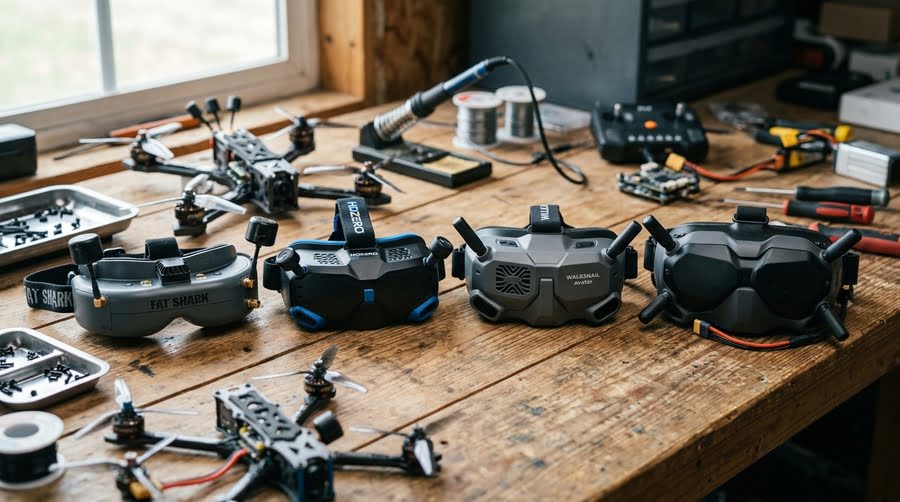
There are analog goggles, digital goggles, different display technologies, different video ecosystems, and a wide range of prices.
The most important thing to understand is this:
Your goggles are part of a complete video system.
You shouldn’t choose goggles without considering the camera and video transmitter installed on your drone.
How an FPV Video System Works
A basic FPV video system consists of:
Camera → Video Transmitter → Radio/Video Link → Goggles
The camera captures the image.
The video transmitter sends that image.
The goggles receive and display it.
The exact system depends on whether you are using analog or digital FPV.
This means compatibility should be your first consideration when buying goggles.
Analog FPV Goggles
Analog FPV has been used for many years and remains relevant.
The system generally uses an analog camera and analog video transmitter.
Advantages
- Simple technology
- Broad ecosystem
- Low equipment weight
- Relatively affordable
- Suitable for lightweight builds
Limitations
The image quality is significantly lower than modern HD digital systems.
However, some pilots still prefer analog because of its simplicity and characteristics when the signal becomes weak.
Analog is also useful for small builds where minimizing weight and cost matters.
Digital HD FPV
Digital FPV systems provide a higher-resolution image and can create a more immersive flying experience.
Digital systems are particularly attractive if you care about:
- Image clarity
- Detail
- Immersion
- Easier visual identification
- Modern video features
The trade-off is that digital hardware can be more expensive and often adds more weight.
HDZero
HDZero is one of the established digital FPV ecosystems.
It is known for digital video and is particularly relevant to pilots who value responsive flying and predictable video behavior.
When choosing HDZero equipment, make sure your goggles or receiver are compatible with the HDZero video hardware installed on the drone.
Walksnail
Walksnail is another digital FPV ecosystem focused on HD video.
It offers camera and video transmitter combinations designed for digital FPV builds.
Walksnail can be considered by pilots who want HD image quality across different types of FPV drones.
Again, the goggles need to match the specific video hardware being used.
DJI
DJI has also played a major role in the development of digital FPV equipment.
DJI systems are often considered by pilots who prioritize image quality and an integrated digital video experience.
However, choosing DJI goggles should still involve checking the exact compatibility of the goggles, camera, and video transmitter.
Analog vs. HD: Which Is Better?
There isn’t a universal answer.
Choose Analog If You Prioritize:
- Lower equipment cost
- Lightweight builds
- Simple hardware
- Broad traditional FPV compatibility
Consider HD If You Prioritize:
- Image quality
- Immersion
- More detailed video
- Modern digital systems
- Your flying style also matters.
A lightweight racing quad may have different requirements from a cinematic build carrying an action camera.
Latency Matters, But It Isn’t Everything
Latency is the delay between the camera capturing an image and you seeing it in the goggles.
For fast FPV flying, latency is important.
However, beginners sometimes focus too heavily on a single latency number.
Real-world video performance depends on the complete system, including:
- Camera
- VTX
- Goggles
- Signal conditions
- Video settings
- Resolution
- Distance
- Environmental interference
Instead of comparing one specification, consider the complete video ecosystem.
Display Resolution
Digital goggles can offer significantly higher image resolution than traditional analog systems.
Higher resolution can make it easier to see:
- Trees
- Branches
- Obstacles
- Landing area
- Terrain
This can improve the overall flying experience.
But resolution isn’t the only factor.
A high-resolution display is less useful if the goggles are uncomfortable or incompatible with your drone.
Field of View
Field of view, or FOV, describes how much of the environment you can see through the goggles.
A wider FOV can create a more immersive experience.
However, some pilots prefer a narrower view because it can make it easier to focus on the aircraft’s immediate surroundings.
Again, this is partly personal preference.
Goggles Comfort Is Important
FPV pilots can wear goggles for long periods.
Small differences in comfort can become noticeable over time.
When comparing goggles, consider:
- Weight
- Head strap
- Faceplate shape
- IPD adjustment
- Focus adjustment
- Field of view
- Display size
- Battery arrangement
- Ventilation
A pair of goggles that looks excellent on paper may not be comfortable for your particular face shape.
Don’t Forget IPD and Focus
IPD stands for interpupillary distance—the distance between the centers of your pupils.
If goggles don’t fit your IPD properly, the image may appear uncomfortable or difficult to focus.
Focus adjustment is also important for pilots who wear glasses or have different visual requirements.
These features are easy to overlook when comparing product specifications, but they can have a significant effect on actual usability.
Consider the Weight
Weight is another important factor.
Heavy goggles can become uncomfortable during long sessions.
This is especially relevant if you fly frequently or travel with your equipment.
For some pilots, a lighter pair with slightly fewer features may be more enjoyable than a heavier flagship model.
Choosing Goggles for Different Flying Styles
Racing
Racing pilots may prioritize responsiveness, consistent video, and a clear view of the track.
Freestyle
Freestyle pilots may want a balance between image quality, latency, weight, and comfort.
Cinematic
Cinematic pilots may prioritize image quality and immersion.
Micro Builds
For tiny drones, lightweight goggles and video equipment can complement the lightweight nature of the aircraft.
Don’t Buy Goggles Before Checking Your Drone
One of the most common beginner mistakes is buying goggles first without considering the video transmitter.
Imagine buying a digital headset and then discovering that your drone uses a completely different video system.
Before buying, identify:
Camera → VTX → Video System → Goggles
Then check compatibility.
This simple process can prevent an expensive mistake.
Building a Complete Digital FPV System
If you’re planning an HD build, you need to consider more than the goggles.
A typical system includes:
- Digital FPV camera
- Digital video transmitter
- Compatible goggles
- Antennas
- Power requirements
- Mounting space
Digital systems can also affect drone weight and power consumption, so make sure the video hardware fits the overall build.
Where to Compare FPV Goggles
If you’re still deciding between analog and HD, browsing several goggles in one category can make the differences easier to understand.
MEPSKING’s FPV goggles category is one example of a place where pilots can compare different goggles and video systems while planning an FPV setup.
The important part is to use the category as a starting point and then check the compatibility of the complete video system before purchasing.
Common Beginner Mistakes
Buying Based Only on Resolution
Higher resolution isn’t automatically better for every type of flying.
Ignoring Compatibility
The goggles must work with the video system on the drone.
Forgetting Weight
Heavy goggles can become uncomfortable.
Ignoring Fit
IPD and focus adjustment can have a major impact on usability.
Buying for a Future Drone That Doesn’t Exist Yet
Choose equipment based on a realistic upgrade path rather than hypothetical features you may never use.
Final Thoughts
FPV goggles are a personal part of your setup.
The right choice depends on:
Video system → Flying style → Image quality → Latency → Weight → Comfort → Future compatibility
Analog remains useful for pilots who prioritize simplicity and lightweight equipment, while HD systems provide a more detailed visual experience.
Instead of asking which goggles are universally the best, start by asking:
What video system do I want to fly, and what characteristics matter most to me?
Once that question is answered, the number of suitable options becomes much smaller—and choosing your first pair of FPV goggles becomes considerably easier.
