Fintechzoom Adobe Stock Strategies for Successful Investment
Note: FintechZoom Pro is independent and not affiliated with, endorsed by or associated with FintechZoom.com or FintechZoom.io. "FintechZoom" in this title is the search term readers use, not a reference to that company. This guide is for information only, not financial advice.
FintechZoom Adobe stock refers to shares of Adobe Inc. (Nasdaq: ADBE), the software company behind Photoshop, Acrobat and Creative Cloud, whose price is driven mainly by subscription growth, product innovation such as AI tools, competition and quarterly earnings. This guide explains what Adobe does, the factors that move its stock, common investment approaches and how to buy shares. It is general information, not investment advice.
Adobe at a glance:
- Business: creative, document and digital marketing software.
- Founded: 1982 by John Warnock and Charles Geschke.
- Headquarters: San Jose, California.
- Ticker: ADBE on the Nasdaq; a member of the Nasdaq-100 and S&P 500.
- Key products: Creative Cloud, Adobe Acrobat and Adobe Experience Cloud.
What is Adobe Inc.?
Adobe Inc. is an American multinational software company best known for digital media and digital marketing software. John Warnock and Charles Geschke founded it in 1982. Its first major product was PostScript, a page description language that was central to the desktop publishing revolution. Adobe has since expanded into many other fields and is based in San Jose, California.
What are Adobe's main products?
Adobe's core products are Creative Cloud, Adobe Acrobat and Adobe Experience Cloud.
| Product | What it is | Main users |
|---|---|---|
| Creative Cloud | Subscription to apps such as Photoshop, Illustrator and After Effects | Graphic designers, photographers, video editors |
| Adobe Acrobat | Software for the PDF format, which changed how people read and share documents across devices and operating systems | Businesses and individuals |
| Adobe Experience Cloud | Digital marketing and analytics tools for managing and analysing an online presence | Marketing teams and enterprises |
How has Adobe stock performed?
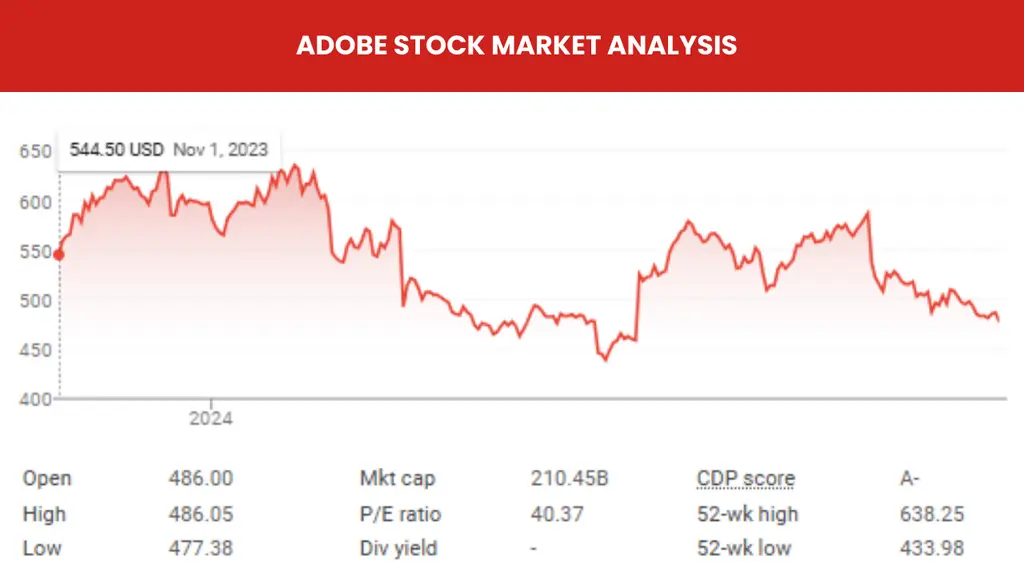
Adobe is one of the world's largest software companies by market capitalisation, and its long-term growth in digital media and marketing has drawn strong investor interest. Over the years its share price has risen significantly, reflecting confidence in its steady innovation and product demand, although the stock has also gone through sharp declines. Its valuation places it among the major technology companies.
What drives Adobe's growth and financial performance?
Adobe's revenue growth comes from strong demand for digital content creation and marketing software, supported by high profit margins. The company has reported strong earnings per share (EPS) in recent years. Adobe agreed in 2022 to buy the design platform Figma, but the two companies abandoned the deal in December 2023 after regulatory opposition, so Figma never became part of Adobe.
What factors influence Adobe stock?
Adobe's share price depends on product innovation, its subscription model, acquisitions and partnerships, the economy, competition and quarterly results.
| Factor | Why it matters | Possible effect |
|---|---|---|
| Product innovation | Upgrades to Photoshop, Illustrator and new AI and cloud tools attract and keep customers | Successful launches support confidence |
| Subscription model | Creative Cloud provides recurring, more predictable revenue | Lower revenue volatility; depends on retention and pricing |
| Acquisitions and partnerships | Can add revenue streams and customers, but deals can fail | Positive if they expand reach; costly if blocked |
| Economy and market trends | Inflation and interest rates affect corporate budgets; demand for digital content and remote work helps | Mixed |
| Competition | Rivals such as Microsoft and Canva compete for users | Lost market share would weigh on the stock |
| Quarterly earnings | Sales, EPS, cash flow and guidance | Surprises move the price up or down |
How does product innovation affect Adobe?
Adobe's success depends heavily on its ability to keep innovating. New features and software updates can attract new clients and retain existing ones. Expanding into areas such as AI-driven content creation and cloud-based services helps Adobe follow industry trends.
Why is the subscription model important?
Adobe's move to subscriptions, especially Creative Cloud, gives it stable recurring revenue and lowers revenue volatility. The model's success depends on customer retention and on Adobe offering attractive membership tiers and pricing.
How do acquisitions and partnerships matter?
Acquisitions can open new revenue streams and broaden the customer base, while partnerships in digital marketing and cloud computing can expand Adobe's reach. The cancelled Figma deal shows that large acquisitions also face regulatory risk.
How do the economy and competition affect Adobe?
As a technology company, Adobe is exposed to inflation and interest rates, which can affect corporate software budgets. At the same time, demand for digital content and remote work tools supports its business. Adobe also competes with Microsoft and Canva, particularly among small businesses and individual users, so keeping its competitive edge is important for investor confidence.
Why do quarterly earnings matter?
Quarterly earnings reports show Adobe's actual sales and its outlook, and they often trigger large price moves. Investors watch measures such as EPS and cash flow; results above expectations can lift the stock, while misses can push it down.

What are common investment approaches for Adobe stock?
Investors typically approach Adobe through long-term holding, dollar-cost averaging, active trading, funds or options, depending on their goals and risk tolerance. Each approach carries different risks.
| Approach | How it works | Risk level | Best suited to |
|---|---|---|---|
| Long-term holding | Hold shares for years to follow the company's growth | Moderate | Patient investors who can ride out price swings |
| Dollar-cost averaging | Invest a fixed amount at regular intervals | Moderate | Those wary of investing a lump sum at once |
| Growth and momentum trading | Trade around earnings releases and product launches | High | Experienced, active traders |
| ETFs and mutual funds | Own Adobe as part of a broader tech or index fund | Lower (diversified) | Investors who want diversification |
| Options trading | Use calls or puts to speculate on price moves | Very high | Experienced traders who understand options |
What is long-term growth investing in Adobe?
Long-term investors hold Adobe for several years to benefit from its revenue growth and expansion into AI and digital marketing. This approach requires patience and a focus on long-term potential rather than short-term price fluctuations, and it still carries the risk that growth slows.
How does dollar-cost averaging work?
Dollar-cost averaging means investing a set amount in Adobe stock regularly, whatever the current price. You buy shares at different prices, which smooths your average cost over time and reduces the risk of investing a large sum at a bad moment. It suits people with a medium- to long-term outlook. Value averaging is a related method that adjusts the amount invested to hit a target growth path.
What is growth and momentum trading?
Traders with high risk tolerance try to profit from short-term price moves around earnings releases or major product updates. This requires time, expertise and quick reactions to market changes, and it can lead to losses for less active investors.
Why invest through ETFs and mutual funds?
Technology or index funds that hold Adobe spread your risk across many companies. Adobe is held in major funds that track the Nasdaq-100 index and the S&P 500. Diversification reduces single-stock risk, but your gains from Adobe's own growth are diluted.
What about short-term options trading?
Options let traders speculate on Adobe's price moving up (calls) or down (puts), often around earnings announcements. This is a high-risk strategy that needs a thorough understanding of options; it can produce large gains but also total loss of the premium paid, so it is only appropriate for experienced traders.
How do you invest in Adobe stock?

Open a brokerage account, research Adobe's finances, decide how much to invest, choose your strategy and place a market or limit order.
- Find a reliable online brokerage that gives access to Adobe shares. Check its commissions and any account minimums.
- Review Adobe's latest financial statements, including revenue and cash flow, to judge its financial health.
- Decide how much you are willing to invest based on your goals and risk tolerance.
- Choose your approach, for example long-term buy-and-hold if you plan to keep the shares for years.
- Place a market order (buys at the current price) or a limit order (buys only at your chosen price or better), then confirm the transaction.
Key takeaways
- Adobe's strong position in digital media and its subscription model make it widely followed by technology investors.
- Innovation, AI tools, competition and quarterly results are the main drivers of the share price.
- The planned Figma acquisition was abandoned in December 2023.
- Stay up to date on Adobe's results and news, and match any approach to your own risk tolerance.
Adobe stock FAQs
Is Adobe stock a good investment these days?
That depends on your goals and risk tolerance. Adobe has strong products and recurring revenue, but it faces competition, AI disruption and valuation risk, and no one can reliably predict its share price.
Who are Adobe Stock's main competitors?
Adobe Stock, Adobe's stock photo marketplace, competes with Shutterstock, Getty Images, iStock, Dreamstime, 123RF, Depositphotos and Alamy. Adobe the company competes with firms such as Microsoft and Canva.
What is the minimum withdrawal amount from Adobe Stock?
For contributors selling content on the Adobe Stock marketplace, the minimum payout is $25. You must have at least this amount in your account before requesting a payout.